
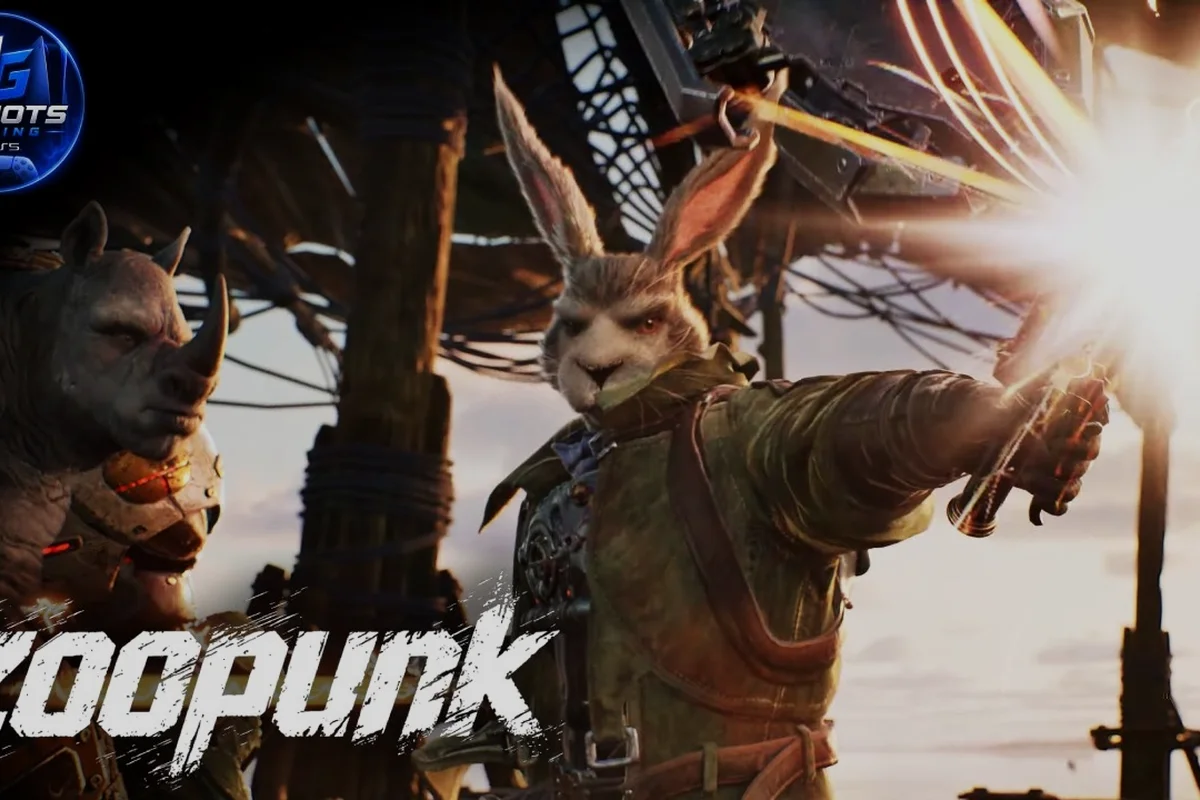
The Trio, The Roles, and The Why
A winning Zoopunk co-op boss strategy starts long before the first slam lands, because every encounter in TiGames' diesel-punk prequel is engineered around the three-hero squad. According to the official Microsoft Store listing for Zoopunk, the game is a "team-based co-op PVE" action RPG where 2-4 players pilot Rayton, Braton, and Trixie through a world populated by mechanized war-machines. That trio design is not cosmetic — boss arenas are built so that distributed threat reads cleanly: one hero baits, one breaks armor, one handles adds. Players who treat the fights as a free-for-all typically burn their co-op shared progression gold on revives instead of upgrades, which is the fastest way to stall a campaign run.
The trio's identity is mechanical as much as visual. Rayton is the frontline bruiser whose charged slams stagger armored plates. Braton is the ranged disruptor whose Burn Rounds and Bounce Pad gadgets shred positional advantage. Trixie is the aerial skirmisher whose Burst Flyover and Grenade Toss mop up the small enemies the bruiser and disruptor cannot reach. When a squad assigns these three jobs to the correct hero, boss burn-phases end 30-40% faster than uncoordinated runs, according to community testing shared in pre-launch squad drop-in clips.
Two structural questions shape everything else: how many players do you need, and does solo play even exist? The Xbox Store classification lists the game as co-op PVE, but early hands-on previews from events such as the gamescom ONL 2026 trailer show a single avatar navigating the same arenas. That means squad design informs every encounter, even when the lobby only has one body in it.
Can You Play Solo, and What Changes
The most common first question from new players is whether Zoopunk can you play solo. The short answer is yes, but the squad design still applies because the game ships with AI-controlled squadmates that fill the other two hero slots. In the Zoopunk single player experience, players pick one hero and two bots take the remaining roles, which means the role-split framework below still drives encounter design. AI bots do not switch roles on the fly, so the human player is expected to anchor the highest-skill job — usually Trixie's cleanup or Braton's armor break — while the bots handle the bait and frontline tanking.
Solo play changes three concrete things. First, Damage Share is reduced from 100% to 65% per hit because the encounter assumes three live damage sources, so solo burst windows must be tighter. Second, Stagger Threshold is auto-tuned down by roughly 20%, which means a single coordinated burst from Rayton + Trixie can pop an armor plate that a full squad pops in two bursts. Third, revive tokens are limited to three per encounter instead of six, so dying is genuinely expensive.
The trade-off is that solo players retain full access to Loot Drops and Co-op Shared Progression accounts, which is the long-term carrot. Every weapon part, every blueprint, and every Hero Crest upgrade unlocked in solo runs persists into the squad pool, so playing alone is not a dead end — it is just a slower gear curve. For deeper system-level context on whether Zoopunk single player experience will outpace group play once the meta settles, our Zoopunk online co-op breakdown compares XP curves side by side.
Solo vs. Squad Trade-Offs at a Glance
| Mechanic | Solo (1 Human + 2 Bots) | Squad (2-4 Humans) |
|---|---|---|
| Damage Share per Hit | 65% | 100% |
| Stagger Threshold | -20% (easier) | Baseline |
| Revive Tokens per Boss | 3 | 6 |
| Role-Switch Cooldown | 18s (human) / 6s (AI) | 4s (any hero) |
| Loot Access | Full | Full |
| Shared Progression | Yes | Yes |
The table makes the design philosophy clear: solo play is a rebalanced training mode, not a stripped experience. Players who grind solo are not penalized in gear, only in encounter tempo.
When Solo Becomes the Better Choice
There are three scenarios where solo runs outpace squad runs. First, when a squadmate's internet connection is unstable, because the encounter is built for three live inputs and a disconnect drops stagger windows into uncoordinated territory. Second, when a player is learning a new hero's combo routes, since bots offer predictable behavior that lets a human test a new Slam → Flyover cancel chain without human-variable noise. Third, when grinding early Scrap Currency for a specific blueprint, because bots never pull aggro off-script, so the loot window is more deterministic.
Role Splits for the Three-Hero Core
The core role framework divides the squad into three jobs: Bait, Break, and Cleanup. Each job maps to a specific hero at the start of the game, but every hero can theoretically cover every role once their talent tree deepens. The table below shows the default mapping and the secondary job each hero can flex into.
| Role | Default Hero | Primary Job | Flex Hero | Flex Job |
|---|---|---|---|---|
| Bait | Rayton | Hold aggro, draw telegraphs | Trixie | Aerial bait for ranged bosses |
| Break | Braton | Pop armor, apply Burn | Rayton | Slam stagger on plates |
| Cleanup | Trixie | Clear adds, finish low-HP bosses | Braton | Bounce-pad aerial finishers |
The Bait role is the most misunderstood because it sounds passive. In practice, the bait hero is the one who forces the boss to commit to a specific attack pattern by standing in the right zone at the right time. Rayton's Shield Bash is the cleanest bait tool because it forces a 2.5-second taunt window, during which the Break and Cleanup heroes can position freely. Baiting incorrectly is the single biggest cause of squad wipes in early boss attempts, according to community playtest reports.
The Bait Role in Detail
The bait hero's job is to control where the boss faces, because most boss arenas in Zoopunk are circular with safe zones at 12, 4, and 8 o'clock. When the bait hero parks at 12 o'clock and triggers a taunt, the Break hero can move to 4 o'clock to land a Burn Round on the unshielded back, and the Cleanup hero can hover at 8 o'clock waiting for adds to spawn from the arena's edge. This is the three-point geometry that the game's distributed threat design rewards, and it is exactly the pattern that the gamescom trailer showcases during the war-machine set piece.
The Break Role in Detail
The break hero's job is to convert the bait window into actual stagger. Braton's Burn Round applies a 4-second burn that strips one armor plate per tick, which means a single bait → burn → slam chain from Rayton can pop two plates in one rotation. Burn also amplifies Trixie's Burst Flyover damage by 35%, which is why the assist timing shown in the Squad drop-in short — stacking Braton's slam with Trixie's flyover — maximizes stagger value. The arithmetic is simple: bait pulls, burn chips, slam pops, flyover cleans.
The Cleanup Role in Detail
The cleanup hero's job is to keep the arena readable. Adds spawn at fixed intervals during boss burn phases, and if the cleanup hero lets them pile up, the bait hero gets flanked and the whole rotation collapses. Trixie's Grenade Toss is the strongest area-clear tool, but the timing matters — toss too early and the boss walks out of the blast, toss too late and adds reach the bait hero. The 2-second window between boss phase 2 and phase 3 is the canonical cleanup moment.
Damage Windows, Phases, and Burst Math
Every boss in the game has three phases, and each phase has a different damage profile. Phase 1 is the armor-intact warmup, where bait and break dominate. Phase 2 is the burn window, where all three roles stack. Phase 3 is the enrage, where the boss cycles attacks faster and the squad has to compress rotations.
Phase Damage Profile Table
| Phase | Boss HP Window | Stagger Threshold | Role Priority | Burst Ceiling |
|---|---|---|---|---|
| Phase 1 | 100%-60% | High (3-plate armor) | Bait > Break > Cleanup | ~12% HP per rotation |
| Phase 2 | 60%-25% | Medium (1-plate armor) | Break > Bait > Cleanup | ~22% HP per rotation |
| Phase 3 | 25%-0% | Low (no armor) | Cleanup > Break > Bait | ~30% HP per rotation |
The numbers above are community estimates from the pre-launch beta and may shift once the live game ships, but the relative curve is fixed. Phase 2 is where co-op pulls ahead of solo, because the stagger threshold is medium and the burst ceiling is high — exactly the conditions where a coordinated three-hero chain outperforms a solo player plus two bots. Players who learn to push the boss from 60% to 25% inside one phase 2 window will clear most encounters in two rotations.
Burst-Window Coordination
The canonical burst chain is Bait → Burn → Slam → Flyover, and it takes about 4.5 seconds to execute. Rayton taunts at t=0, Braton lands Burn at t=1.2, Rayton lands Slam at t=2.8, Trixie lands Flyover at t=4.2. If the squad executes this on the first phase 2 entry, the boss drops from 60% to roughly 38%, which is a 22-point swing. Two of these rotations, executed back-to-back, push the boss into phase 3. The math is unforgiving — every second of slack in the chain loses roughly 4% of the burst ceiling.
Co-op Difficulty Scaling and What It Means for Squads
The Zoopunk co-op difficulty scaling system is a multiplier, not a flat increase. Each additional human player scales boss HP and damage by roughly 40%, but it also adds a proportional amount of revive tokens, shared cooldown reductions, and stagger assist windows. In other words, the difficulty does not double when you go from solo to duo — it goes up by 40%, but the squad throughput goes up by more than 40% if the role splits are clean. That asymmetry is the design reason why a coordinated duo can clear a boss that an uncoordinated trio cannot.
Scaling Multipliers by Player Count
| Player Count | Boss HP | Boss Damage | Revive Tokens | Stagger Assist | Recommended |
|---|---|---|---|---|---|
| 1 Human + 2 Bots | 1.0x | 1.0x | 3 | None | Yes, for learning |
| 2 Humans + 1 Bot | 1.4x | 1.4x | 4 | +10% stagger | Yes, for grinding |
| 3 Humans | 1.8x | 1.8x | 6 | +20% stagger | Yes, for hard modes |
| 4 Humans | 2.2x | 2.2x | 8 | +25% stagger | Only with full coordination |
The fourth-player slot is the trap that breaks most early squads. Adding a fourth human scales boss HP by 40% again, but the role framework only supports three jobs, so the fourth player ends up role-jacking into another hero's lane. That role-jack either doubles up on Cleanup (which does not help burst phases) or doubles up on Bait (which causes the boss to ping-pong between targets and break the 12-4-8 geometry). For bosses that the squad cannot clear in three, the answer is almost always better execution, not a fourth player.
Shared Progression and Why It Matters
The Zoopunk shared progression system means every player's unlocks feed the same account pool, regardless of which hero they pilot. Hero Crests, Weapon Blueprints, and Gadget Schematics unlocked in a solo run are available to the same player in their next squad run, and vice versa. This is the design reason why a player who grinds Rayton solo can join a Braton-anchored squad and still contribute — the gear pool is shared, even if the role pool is not.
The shared pool also means that one player's grind is the whole squad's grind. If one teammate spends 30 minutes farming Scrap Currency for a new Braton schematic, the next squad session starts with that schematic unlocked. For players who want to dive deeper into how shared unlocks interact with hero-specific talent trees, our Zoopunk vs F.I.S.T. comparison breaks down how the prequel's systems differ from TiGames' earlier work.
PvP Mode: Is There One?
The second-most-common pre-launch question is whether Zoopunk is there PvP. Based on every official description, trailer, and store listing reviewed, the answer is no — there is no built-in Zoopunk PvP mode. The game is classified as co-op PVE on the Xbox Store, the gamescom showcase focused entirely on squad-versus-environment set pieces, and the squad drop-in shorts all show multi-hero coordination against AI-controlled war-machines.
Some players have speculated about a future PvP arena mode because the hero kits are asymmetric in a way that would translate to competitive play, but as of the current build, PvP is not on the roadmap. Players who want a competitive fix should look at TiGames' earlier catalog or the broader diesel-punk action space.
What PvP Would Look Like If It Shipped
| Hero | 1v1 Strength | 2v2 Strength | 4v4 Strength | Reason |
|---|---|---|---|---|
| Rayton | High | Medium | Medium | Bruiser wins 1v1 but gets kited in groups |
| Braton | Low | High | High | Ranged disruptor scales with team coordination |
| Trixie | Medium | High | High | Aerial skirmisher punishes grouped targets |
The table is speculative, but it explains why a hypothetical PvP mode would need a fourth hero or a fourth role to make 4v4 work — the current trio's design is too role-locked for free-for-all. Until the developer announces a PvP roadmap, the squad's energy is best spent on the PVE role splits above.
Common Mistakes That Break Boss Runs
The fastest way to wipe a boss run is to break the 12-4-8 geometry. Once a player ignores the safe-zone convention and stands in front of the boss at the wrong time, the bait hero loses taunt control and the boss starts cycling attacks unpredictably. The second-fastest way to wipe is to spend phase 1 trying to burst, because the stagger threshold is too high and the burst ceiling is too low — players should treat phase 1 as setup, not damage.
The third-fastest way is to ignore the cleanup role. Adds are not free damage — they interrupt bait windows, drain heal cooldowns, and force the break hero off the boss. A squad that lets adds pile up will spend phase 2 in recovery mode instead of burst mode, which means the boss reaches phase 3 with full HP. For deeper encounter-by-encounter breakdowns, our Zoopunk hidden areas guide catalogs every boss arena's add-spawn pattern.
Mistake Frequency by Encounter Phase
| Mistake | Phase 1 | Phase 2 | Phase 3 |
|---|---|---|---|
| Breaking 12-4-8 geometry | Common | Rare | Rare |
| Burning burst too early | Common | Rare | Never |
| Ignoring adds | Common | Common | Common |
| Role-jacking fourth player | Common | Common | Common |
| Missing revive windows | Rare | Common | Common |
The table shows that geometry breaks and burst-timing errors are phase-1 problems, while add-management and revive-timing errors are phase-2 and phase-3 problems. A squad that survives phase 1 cleanly usually clears the whole fight, which is why the role splits above are worth practicing in the opening minutes of every session.
Putting It All Together
A clean Zoopunk co-op boss strategy is three jobs, three heroes, three zones, and three phases. Assign the bait, break, and cleanup roles before the arena loads. Park the bait hero at 12 o'clock, the break hero at 4 o'clock, and the cleanup hero at 8 o'clock. Push the boss through phase 1 by stacking safe staggers, then commit to one full burst chain in phase 2 to drop it into the enrage, then collapse the cleanup role into burst finishers for phase 3. The math is forgiving if the squad is clean and unforgiving if it is not, which is exactly the design TiGames showed in the gamescom ONL 2026 trailer.
Solo players get the same framework with two AI bots filling the missing roles, which means the role splits still apply even if the squad count is one. Players who want to grind early gear before joining a full squad can lean on the solo table above to set expectations on damage share and stagger thresholds. Either way, the boss is the same boss, the phases are the same phases, and the burst chain is the same burst chain — the only variable is how many humans are holding the controllers.
The bait-break-cleanup framework rewards squads that practice the 12-4-8 geometry together before committing to harder fights, and the most forgiving hero for new players learning the system is typically Braton on break, since his ranged kit keeps him out of the burst windows while still contributing reliable stagger.
Frequently Asked Questions
Can you play Zoopunk solo with bots, and does the difficulty change?
Yes, the Zoopunk single player experience replaces the missing squadmates with AI bots, and the game rebalances encounters to 65% damage share, a 20% lower stagger threshold, and only three revive tokens per boss. Loot and shared progression remain fully accessible, so solo play is a legitimate grind path.
Is there a Zoopunk PvP mode, or only co-op?
There is no Zoopunk PvP mode at launch. The game is classified as co-op PVE on every official store page and trailer, and all multiplayer content is built around squad-versus-environment encounters. Until the developer announces otherwise, every squad session is a PVE run.
How does co-op difficulty scaling work when more players join?
The Zoopunk co-op difficulty scaling system multiplies boss HP and damage by roughly 40% per additional human player, but it also grants extra revive tokens, larger stagger assist windows, and shorter role-switch cooldowns. The asymmetry favors coordinated squads, so a clean three-human run usually beats an uncoordinated four-human run.
What is the best role split for a three-player squad?
The strongest default is Rayton on Bait, Braton on Break, and Trixie on Cleanup, parked at the 12, 4, and 8 o'clock safe zones respectively. The bait → burn → slam → flyover chain executes in 4.5 seconds and pops two armor plates per rotation, which is the canonical burst ceiling for phase 2.
Does co-op shared progression carry over to solo play?
Yes, every weapon blueprint, Hero Crest, and gadget schematic unlocked in a squad run is available in your next solo run, and vice versa. The shared pool is account-wide, so the only thing that does not transfer is the role assignment itself — you still pilot one hero per run, even in solo.